Project Description
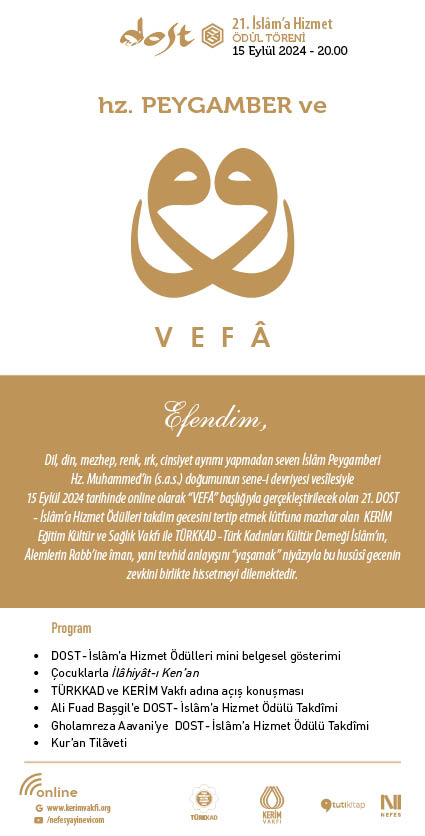
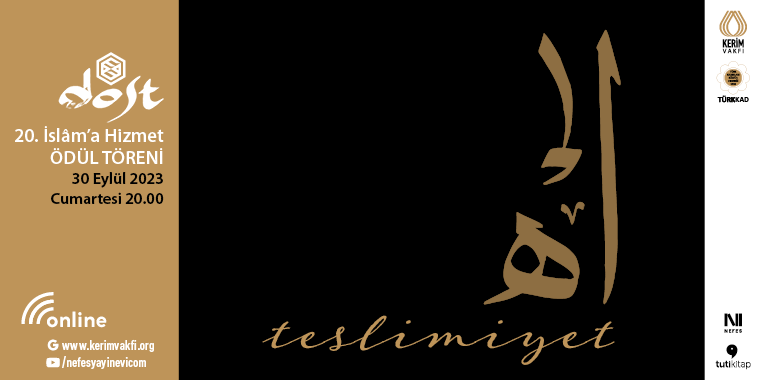
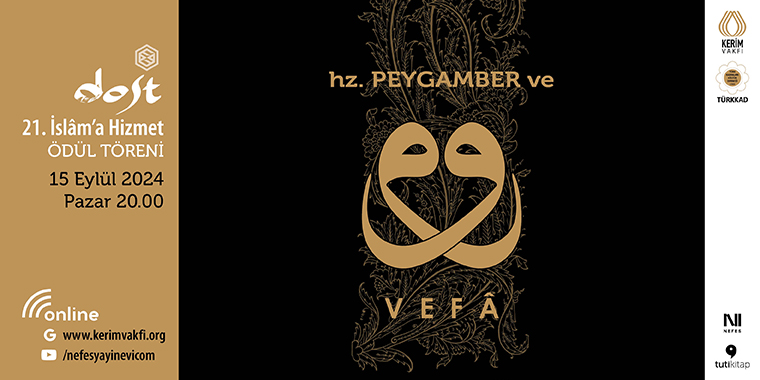
“Vefâ” (Loyalty) Themed 21st DOST Award for Service to Islam Presentation Ceremony
The “Vefâ” (Loyalty) themed 21st DOST Award for Service to Islam presentation ceremony will be held ONLINE on Sunday, September 15.
The “DOST” Award for Service to Islam, presented every year with the aim of commemorating the anniversary of the birth of Hz. Muhammad (peace be upon him), who was sent as a mercy to all the worlds, and his love that gathers everyone under the banner of tawhid, will find its recipients at the ceremony to be held ONLINE on Sunday, September 15.
The 21st “DOST” Award for Service to Islam, to be presented at the evening themed “Vefâ” (Loyalty), is awarded to Ali Fuat Başgil from Turkey and to Gholamreza Aavani from abroad.
AWARD CEREMONY DATE: Sunday, September 15, 2024, Time: 20:00
Sponsors of the Evening: Nefes Yayıncılık and Tuti Kitap
Participation is open to everyone and free of charge.
***The live broadcast of the 21st DOST – Award for Service to Islam Presentation Evening is carried out by Nefes Yayınevi A.Ş.
See here for his biography.
Prof. Dr. Gholamreza Aavani was born in February 1943 in the city of Semnan, Iran, as one of seven siblings within a large family. His father, Zeynelabidin, was a carpet merchant in the Semnan Bazaar and a part-time farmer who spent the rest of his time growing pomegranates and grapes. His mother, Kokab, was a homemaker who cared for her family and wove carpets in her spare time. Growing up in Semnan, surrounded by desert and known for its gentle yet resilient people, deeply shaped Professor Aavani’s outlook on life and taught him the virtue of contentment.
One of his first teachers, his uncle Dayi Molla Alireza, introduced young Gholamreza to examples of classical Persian literature such as Sa’di’s Gulistan and taught him Arabic. He was fortunate to complete his primary, secondary, and high school education in Semnan; for during the education he received there, he was nurtured by dedicated educators who instilled in him a lasting passion for knowledge. His parents were people who placed the utmost importance on education—not only for Gholamreza but also for his sisters—at a time when the education of girls was often neglected, and who did not allow their modest financial circumstances to hinder their children’s education. His sisters went on to pursue studies in law and philosophy. With his family’s support, Gholamreza too began learning English in Semnan, even though there were no schools offering formal English instruction at the time, and improved his English on his own with the help of a dictionary and newspaper clippings he managed to obtain. His determination and academic achievements earned him a prestigious state scholarship that opened the doors of the American University of Beirut.
His years at the American University of Beirut became one of the turning points in Gholamreza’s life, where he developed a serious interest in Western philosophy. It was there that he first met Seyyed Hossein Nasr. Nasr’s influence on Gholamreza was significant in terms of the inspiration he provided, particularly in fostering his interest in Islamic philosophy—especially the works of Ibn Sina and Suhrawardi al-Maqtul—and in Islamic Sufism.
After completing his studies in Beirut, Gholamreza enrolled in the Department of Philosophy at the University of Tehran in order to continue his philosophical education. There, he carried out his work under the supervision of Nasr and other leading philosophers such as Fardid. He completed his doctorate in philosophy in 1975, attaining the title of Assistant Professor, and later became Professor of Philosophy at Shahid Beheshti University. During his years of teaching at the university, he focused on Ancient Greek philosophy—particularly Plato and Aristotle—as well as the Philosophy of Art and Islamic Philosophy.
In 1985, he was appointed President of the Iranian Academy of Philosophy, founded in 1974 by Seyyed Hossein Nasr and later known as the Iranian Institute of Philosophy. Under Professor Aavani’s leadership, the Institute became one of the leading centres of Islamic and Western philosophy in the Middle East. Among the Institute’s aims were to serve as a research centre across the various branches of philosophy—such as logic, philosophy of mind, Islamic philosophy, and comparative philosophy—and to invest in matters such as the editing of early Islamic manuscripts, especially the works of Ibn Sina. In addition to providing those interested with a doctoral-level graduate program and various research opportunities, the Iranian Institute of Philosophy has hosted numerous international events to promote philosophical knowledge and has pioneered the delivery of free public lectures.
Professor Aavani has been a member of the Iranian Academy of Sciences since 2006. He has been honoured with many prestigious international awards, including the Distinguished Scholar Medal (2023) conferred upon him by Al-Farabi University in Kazakhstan and the Distinguished Sciences Medal awarded by the Iranian Academy of Sciences. He has served on the Board of Directors of the International Federation of Philosophical Societies (FISP) since 2008. In 2009, he founded the International Society for Islamic Philosophy, also within FISP. Professor Aavani has also served as a visiting faculty member at the Institute for Advanced Humanistic Studies (IAHS) in Beijing. Among his major works are “Rumi: A Philosophical Study” and “The Splendour of Wisdom: A Critical Engagement with Western Philosophy”.
Professor Aavani is grateful to his wife, Mrs. Parvaneh, who made all these achievements possible through her support and love. The couple has two children, Latifeh and Nariman, who inherited their passion for philosophy from their father. Latifeh specializes in the philosophy of law, while Nariman carries out studies on the comparative examination of Indian and Islamic philosophies.