
Project Description
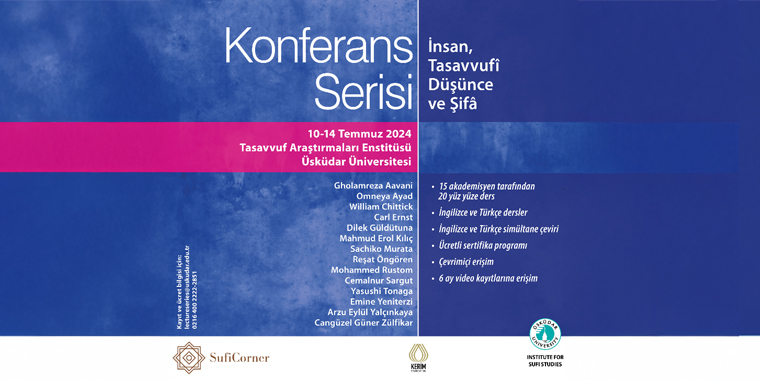
With the support of Üsküdar University Institute for Sufi Studies, Sufi Corner and Kerim Foundation, an educational program in the format of a lecture series was organized from 10 to 14 July 2024 under the title “Human Being, Sufi Thought and Healing”. The program was held in person at Üsküdar University. The languages of the program are English and Turkish.
Application deadline: Wednesday, 3 July 2024
This is a fee-based educational program organized by Üsküdar University Institute for Sufi Studies.
Participants received a Program Certificate from Üsküdar University.
In the program, 15 researchers delivered 20 lectures.
Participants had the opportunity to meet these researchers in person and to ask them questions.
The lectures could also be followed online.
All lectures were provided with Turkish and English simultaneous interpretation.
After the program, the video recordings of the lectures remained accessible to participants for 6 months.
All those interested may apply to the program at lectureseries@uskudar.edu.tr.
Contact numbers: 0090 216 400 2222 – 2851
For program details, CLICK HERE.
Speakers:
Gholamreza Aavani: Professor Gholemreza Aavani is an Iranian philosopher and a retired professor of philosophy at Shahid Beheshti University in Tehran. He graduated with a bachelor’s degree in philosophy from the American University of Beirut in 1964. After receiving his master’s degree in philosophy from the University of Tehran in 1968, he completed his doctorate at the same university in 1976 under the supervision of Seyyed Hossein Nasr. Aavani has played a major role in accelerating the development and dissemination of Iranian philosophy. He is also a member of the Steering Committee of the International Federation of Philosophical Societies and the first president of the International Society for Islamic Philosophy. He has also served as Kenan Rifai Distinguished Professor of Islamic Studies at Peking University in China.
Omneya Ayad: Asst. Prof. Dr. Ayad completed her undergraduate studies in Journalism and Mass Communication at the American University in Cairo and immediately afterwards pursued undergraduate studies at the Academy of Sufi Arabic and Islamic Studies at Al-Azhar University. After completing her master’s degree at the American University in Cairo, she began her doctorate at the Institute of Arab and Islamic Studies at the University of Exeter in the United Kingdom. She received her doctoral degree with a thesis on “Ibn ʿAjība (d. 1224/1809) and the Vast Expertise of the Qur’an: Love in the Moroccan Sufi Tradition.” During her master’s studies she worked as a research assistant in Islamic History at the American University in Cairo. She also served as a research assistant at the Institute of Arab and Islamic Studies at the University of Exeter during her last two years there and taught Arabic courses to undergraduate students.
William C. Chittick: Professor Chittick is a professor in the Department of Comparative Studies, Department of Asian and Asian American Studies, at Stony Brook University, State University of New York, and is known for his work in the field of Sufism. After receiving his bachelor’s degree in history from the College of Wooster in Ohio, he completed his doctorate in Persian literature at the University of Tehran in 1974. In Tehran he worked in the field of comparative religion in the Department of Humanities at Aryamehr Technical University, and before the Islamic Revolution in Iran he held teaching positions at the Imperial Iranian Academy of Philosophy. In 1979 he returned to the United States and continued his work in religious studies. In 2012 he served for one year as professor at the Ken’an Rifâî Chair of Islamic Studies at Peking University. In this chair he taught courses examining the fundamental questions of Islamic thought and the perspectives of great Sufis such as Ibn Sīnā, Ibn ʿArabī and ʿAbd al-Raḥmān Jāmī. His books have been translated into many languages; he has some twenty-five translated works and numerous articles on Islamic thought, Sufism, Shiʿism and Persian literature. Known especially for works in which he translates into English and interprets the writings of Sufi authors and poets such as Muḥyī al-Dīn Ibn ʿArabī and Mawlānā Jalāl al-Dīn Rūmī, Professor Chittick is currently working on various research projects in Sufism and Islamic philosophy and continues to teach courses on the Islamic classics, Hinduism and other topics in religious studies.
Carl W. Ernst: Professor Ernst became known for his study of comparative religion at Stanford University in 1973. After receiving his doctorate from Harvard University in 1981, Ernst taught at Pomona College from 1981 to 1992. Focusing on West and South Asia, Ernst’s published research, based on Arabic, Persian and Urdu sources, falls mainly into three areas: general and critical issues in Islamic studies, premodern and contemporary Sufism, and Indo-Muslim culture. In 2005 Ernst received the “DOST Award for Service to Islam” for his book Following Muhammad: Rethinking Islam in the Contemporary World, which has been translated into Turkish. In 2009, on behalf of the Department of Religious Studies at the University of North Carolina at Chapel Hill, he established the Ken’an Rifai Chair of Islamic Studies in partnership with TÜRKKAD. His work on Sufism has focused on the literary, historical and contemporary aspects of Islamic Sufism, particularly in the context of the Indian subcontinent and Iranian culture. He is co-director of the UNC Center for Middle East and Islamic Studies and associate editor of the Islamic Civilization and Muslim Networks series of the University of North Carolina Press.
H. Dilek Güldütuna: Asst. Prof. Dr. Güldütuna graduated from the Cerrahpaşa Faculty of Medicine of İstanbul University. She completed her specialization in anesthesiology at Koşuyolu Heart and Research Hospital. In Frankfurt she completed a three-year course of Arabic studies at Prof. Fuat Sezgin’s Institute for the History of Arabic-Islamic Science. Between 2005 and 2011 she completed her doctorate in Islamic Studies at Johann Wolfgang Goethe University Frankfurt with her thesis titled “Konstruktionen des weiblichen bei Ken’ân Rifâî: Das weibliche als Spiegel der göttlichen Wirklichkeit” (Woman as the Mirror of the Divine in Ken’an Rifai), and her master’s degree in the Department of Islamic and Religious Studies at the same university with her thesis titled “Buchstabensymbolik bei Ibn Arabî” (Letter Symbolism in Ibn ʿArabī). She currently teaches courses on Sufism at Johann Wolfgang Goethe University Frankfurt. Her main areas of interest include symbolism, letter symbolism in Ibn ʿArabī, the role of women in Islamic Sufism, femininity and masculinity as symbols, and the role of Islamic culture in the history of thought and science and its influence on the West.
Kenan Gürsoy: Prof. Dr. Kenan Gürsoy completed his higher education in France at the University of Rennes and Paris-Sorbonne University (Paris IV). He began his career as an assistant in the Department of Philosophy, Faculty of Letters, Atatürk University. He received the titles of Doctor of Philosophy in 1979, Assistant Professor in 1982 and Associate Professor in Systematic Philosophy and Logic in 1983. In the meantime, he was assigned to conduct research for another year in France at the Department of Philosophy of Paris-Ouest-Nanterre-la-Défense (Paris X) (1981-1982). From November 1984 he served as Associate Professor in the Division of History of Philosophy, Department of Philosophy, Faculty of Languages and History–Geography, Ankara University, where he became Professor in January 1989. From 1997 to 2009 he was a faculty member at Galatasaray University, first in the Faculty of Communication and then in the Department of Philosophy of the Faculty of Arts and Sciences, and from 2000 to 2009 he served as Dean of the Faculty of Arts and Sciences at Galatasaray University. Prof. Dr. Kenan Gürsoy, who was Ambassador of the Republic of Türkiye to the Holy See from 2009 to 2014, served for some time at the Ministry of Foreign Affairs after returning to Türkiye in 2014 and retired from state service as Ambassador in 2015. From 2015 to June 2017 he was a faculty member at İstanbul Aydın University and Director of the Center for Western (Garbiyat) Studies. Since 2013 Prof. Dr. Kenan Gürsoy has served as Chair of the Board of Trustees of the Cenan Foundation. His work focuses mainly on moral philosophy, comparative religious ethics, phenomenology, philosophy of existence and Sufism.
Mahmud Erol Kılıç: Mahmud Erol Kılıç was born in İstanbul in 1961. After graduating from the Faculty of Political Science at İstanbul University (1985), he completed a master’s degree in Islamic philosophy at Marmara University (1989) and then defended his doctoral dissertation on the thought of Ibn ʿArabī (1995). He served as Director of the Museum of Turkish and Islamic Arts in İstanbul (2005-2008) and was subsequently appointed Secretary General of the Parliamentary Union of the OIC Member States (PUIC, Tehran), a post he held from 2008 to 2018. He was then appointed Ambassador of the Republic of Türkiye to the Republic of Indonesia (2019-2021). He currently serves as Director General of the Research Centre for Islamic History, Art and Culture (IRCICA), a cultural subsidiary organ of the Organisation of Islamic Cooperation (OIC). Ambassador Kılıç is married with two children and one grandchild.
Sachiko Murata: Professor Murata graduated in family law from Chiba University in Japan, worked for a year at a law firm in Tokyo and then went to Iran to study Islamic law. After completing her doctorate in Persian literature at the University of Tehran in 1971, she transferred to the Faculty of Theology, where she completed her master’s thesis in Islamic jurisprudence in 1975. While pursuing doctoral studies in law, she also worked as a research assistant at the Iranian Academy of Philosophy. She was unable to complete this second doctoral research when the revolution took place. In 1979 she settled in the United States with her husband, William Chittick. She has been teaching religious studies at Stony Brook University since 1983. From 2012 onwards she taught courses on the fundamental questions of Islamic thought, as well as a course titled “Muslim Confucians”, at the Ken’an Rifâî Chair of Islamic Studies at Peking University, founded under the sponsorship of TÜRKKAD. In this course she taught a work that she had prepared together with William Chittick and Weiming Tu on a great Chinese scholar of the school of Ibn ʿArabī named Huiru.
Reşat Öngören: Professor Öngören graduated from the Faculty of Theology at Marmara University in 1988. At the same university’s Institute of Social Sciences, in the Division of History of Sufism, he completed his master’s degree in 1990 and his doctorate in 1996. From 1996 to 2000 he worked as a researcher on Sufism at the Center for Islamic Studies (İSAM) of the Türkiye Diyanet Foundation. In January 2001 he was appointed Assistant Professor at the Faculty of Theology of İstanbul University. He became Associate Professor in November 2001 and Professor in November 2007. In the 2004-2005 and 2005-2006 academic years he taught as a visiting faculty member at the Higher Islamic Institute in Sofia. Reşat Öngören, who has published many articles, conference papers, encyclopedia entries and book chapters in his field, is the author of the books Osmanlılar’da Tasavvuf: Anadolu’da Sûfîler Devlet ve Ulemâ (İstanbul 2000, 2003, 2012, 2016) and Tarihte Bir Aydın Tarîkatı Zeynîler ([İstanbul 2003], Âlimlerin Gözdesi Bir Tarikat: Zeyniyye, İstanbul 2012). He has also written entries for the 44+2-volume Encyclopedia of Islam (DİA) published by İSAM and for the Arabic encyclopedia Mevsûatu a‘lâmi’l-ulemâi ve’l-udebâi’l-Arabi ve’l-müslimîn , which is being published in Tunisia. He continues to serve as a faculty member at Üsküdar University Institute for Sufi Studies, to which he was appointed on 17 June 2019.
Mohammed Rustom: Mohammed Rustom is Professor of Islamic Thought and Global Philosophy at Carleton University and Director of the Carleton Centre for the Study of Islam. An internationally recognized scholar whose work has been translated into more than ten languages, Professor Rustom focuses his research on Islamic philosophy, Sufism, Qur’anic exegesis and cross-cultural philosophy. He is the author, translator and editor of thirteen books in total, including the recently published Inrushes of the Heart: The Sufi Philosophy of ‘Ayn al-Qudat and A Sourcebook in Global Philosophy. Professor Rustom is also the editor of the “Global Philosophy” series of Equinox Publishing and a member of the Editorial Board of the Library of Arabic Literature.
Cemalnur Sargut: After completing her university education in chemical engineering, she worked as a chemistry teacher. She currently serves as President of the İstanbul Branch of the Turkish Women’s Cultural Association (TÜRKKAD). For more than thirty years she has carried out wide-ranging work in the field of Sufism in Türkiye and abroad. Under the umbrella of TÜRKKAD she has led numerous international symposia, the DOST Awards for Service to Islam and initiatives in Islamic studies. She brought about the establishment of the “Kenan Rifai Distinguished Professorship on Islamic Studies” chairs at the Department of Religious Studies of the University of North Carolina (2009) and at the Institute for Advanced Humanistic Studies of Peking University (2011), as well as the founding of the Kenan Rifai Center for Sufi Studies at Kyoto University in 2015. In 2013 Cemalnur Sargut founded the Kerim Education, Culture and Health Foundation in order to support work in the field of Sufism and to broaden the ground for the study of Sufism in universities. Through this initiative she joined forces with Prof. Dr. Nevzat Tarhan, Founding Rector of Üsküdar University, and together they established the Üsküdar University Institute for Sufi Studies in 2014. Her nearly 30 published works concentrate on studies based on the interpretations of the Holy Qur’an by the great Sufis and on commentaries on the Fuṣūṣ al-Ḥikam. For more than 20 years she has given public talks on the Masnavī and the Fuṣūṣ al-Ḥikam in İstanbul. She regularly gives seminars on Islamic Sufism in countries such as Germany, the United States and India. She currently serves as Advisor to the Rector of Üsküdar University and teaches courses at Üsküdar University.
Yasushi Tonaga: Professor Tonaga is a professor at the Graduate School of Asian and African Area Studies, Kyoto University. He is also director of the Kenan Rifâî Center for Sufi Studies and of the Center for Islamic Studies at Kyoto University. He is a graduate of the University of Tokyo and completed his doctorate at Kyoto University. His main field of research is Ibn ʿArabī and the Akbarian school. He is also president of the Japan Association for Middle East Studies.
Emine Yeniterzi: Professor Yeniterzi graduated from the Department of Turkish Language and Literature, Faculty of Letters, Selçuk University in 1981. In the field of Old Turkish Literature, she completed her master’s degree (1983) with her thesis titled “Divan Şiirinde Hz. Peygamber’in İsim ve Sıfatları-Esmâ-i Nebî” (The Names and Attributes of the Prophet in Divan Poetry: Esmâ-i Nebî) and her doctorate (1989) with her thesis on “Divan Şiirinde Na’t” (The Naʿt in Divan Poetry). She continued her academic career at Selçuk University from 1981 to 2011 and at İstanbul Medeniyet University from 2011 to 2015. She currently works at Üsküdar University Institute for Sufi Studies. Her main fields of study are classical Turkish poetry, textual commentary, religious, moral and Sufi masnavīs, religious genres in verse, and Mawlānā Jalāl al-Dīn Rūmī. She has published nine books, as well as articles in scholarly journals and papers presented at national and international scholarly meetings.
Arzu Eylül Yalçınkaya: Arzu Eylül Yalçınkaya is a faculty member at Üsküdar University Institute for Sufi Studies. Her research examines the points of intersection between Sufism and modernity and secularism, and focuses on Sufi movements of the late Ottoman period. Having written her master’s thesis on the Māturīdī discourses of Ken’ân Rifâî (d. 1950), Yalçınkaya later took graduate courses in religious studies at the Harvard Extension School for three years. Her doctoral dissertation, which examines the life, works and Sufi thought of Ken’ân Rifâî, was published as a monograph (2020). She is currently conducting postdoctoral research as a visiting scholar at the Center for Middle Eastern Studies at Harvard University on “The Bridging Role of Sufi Intellectuals between the Late Ottoman Empire and Early Republican Turkey.” Her recent work on nineteenth-century Sufi acoustic spaces has led to events on Sufi music and poetry at Harvard Divinity School, the Department of Near Eastern Languages and Civilizations and other related venues. Her forthcoming article titled “In Pursuit of Truth: The Perception of Happiness in Jalāl al-Dīn Rūmī’s Masnavī-yi Maʿnavī” and her book written on the monograph of Aḥmad al-Rifāʿī (d. 1182) are in the process of publication.
Cangüzel Güner Zülfikar: Asst. Prof. Dr. Zülfikar graduated from the Department of General Turkish History at the Faculty of Languages and History–Geography (DTCF), Ankara University. She completed her doctoral dissertation titled “Aziz Mahmud Hüdayi Külliyesi’nin Kuruluşu ve İlk Yüzyılı” (The Founding and First Century of the Aziz Mahmud Hüdayi Complex) in the Department of History at Hacettepe University. She has taught courses on Sufism and Islamic civilization at the University of North Carolina at Chapel Hill and at Duke University. She worked as associate director at the Center for the Study of the Middle East and Muslim Civilizations at UNC-Chapel Hill (2006-2010). She founded the Turkish Studies Program at UNC-Chapel Hill (2009) and taught in the program until December 2013. She currently teaches at Üsküdar University Institute for Sufi Studies.